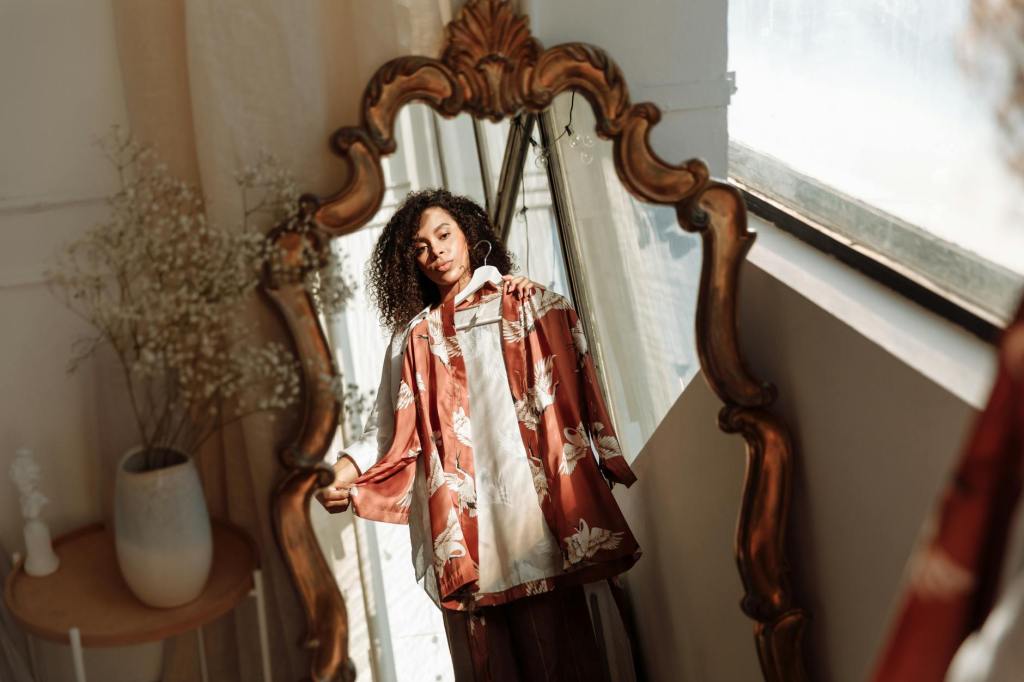
I want you to answer this honestly.
Do you own at least one piece of clothing you’re saving for the “you” of someday?
If you do, notice what actually comes up when you look at it.
Do you feel hopeful?
Do you feel pressure?
Do you feel unworthy?
Those pieces don’t just sit in your closet.
They shape how getting dressed feels.
The Pattern
This is one of the most common patterns I see in people’s wardrobes.
Clothes that don’t fit the way they need them to.
Pieces being saved for later.
Purchases made based on how something might feel in the future instead of how it functions now.
You have a closet full of clothes, but very few that actually support you.
Getting dressed starts to feel like something you’re doing wrong
instead of something that should work.
What I Watched Growing Up
My mom and my grandmother both experienced weight fluctuations, sometimes dramatic ones throughout their lives.
And they both had two closets.
Not metaphorically. Literally.
One was in their main bedroom.
The other was in a different bedroom.
One closet held what they actually wore.
The other held clothes for the version of themselves they were trying to get back to.
The “someday” clothes.
These clothes were often replaced before they were ever worn.
Usually because that aspirational person didn’t show up before trends moved forward and the items no longer fit the fantasy version of this “someday” person.
Not because they were worn out.
But because they were never worn at all.
They would be bought with intention, held onto, and eventually let go of.
Then replaced with something new that represented the same idea.
The clothes changed.
The idea stayed the same.
Where This Shows Up
I see this pattern in different forms.
Closets filled with pieces that technically fit, but don’t feel good to wear.
Items kept out of obligation rather than use.
Clothing that represents a past version of someone, or a future version they haven’t arrived at yet.
And in the middle of it, very little that works easily for the body they have now.
The Internal Layer
This isn’t just practical. It’s emotional.
When your clothes don’t fit the way you need them to, it’s easy to assume you need to change instead.
You may feel the need to take up less space.
To be more socially acceptable.
To quietly pull back from being seen authentically.
I see this in how people choose their clothes.
In what they avoid wearing.
In what they say “isn’t for them anymore.”
In the way they move around their own closets.
What Actually Helps
1. Remove “someday” pieces from your active closet
If something doesn’t fit your current body, take it out of your daily rotation.
You don’t have to get rid of it.
But it shouldn’t be part of your everyday decision-making.
You might find that putting it away makes it easier to eventually let it go.
2. Build a small set of reliable options
Fight the impulse to completely overhaul your closet.
This isn’t a problem that can be solved overnight.
You need a few pieces that:
- fit comfortably
- feel good for a full day
- combine easily with other items
This changes your experience of getting dressed immediately.
3. Choose clothing that allows for variation
Some garments adapt better than others.
Look for:
- knits
- open weaves
- shirring
- elastic waistbands
- silhouettes that don’t rely on precision fit
These choices create flexibility instead of restriction.
4. Pay attention to how things feel, not just how they look
If something feels uncomfortable after an hour, it will affect your entire day.
This matters more than whether it looks good on a hanger.
5. Keep one default outfit
Have at least one outfit you know works.
Something you can put on without thinking
that fits and feels good.
Having this “back-up” ensures you have something to rely on when you don’t have the energy to figure it out.
The Shift
There’s a difference between dressing for the body you have
and dressing for one you’re waiting for.
One supports you.
The other affects your ability to show up in your daily life.
Closing Thought
Bodies change.
But more importantly, people’s relationship to their bodies changes.
And that shows up in clothing.
In what gets worn.
In what gets avoided.
In how visible someone allows themselves to be.
The goal isn’t to resolve that completely.
It’s to build a wardrobe that works with you as you are
instead of asking you to become someone else first.


 ERIN SIMMONS studio
Leave a reply to methum01 Cancel reply